Using pystreme¶
De novo motif discovery from Python, in-process, on the GPU. This is the
practical guide; DESIGNDOC.md has the reasoning, BENCHMARKS.md the
validation against real STREME.
Install and run¶
./scripts/setup_env.sh          # creates the `pystreme` conda env, editable install
conda activate pystreme
pytest                          # CPU-only correctness suite, ~30 s
fit needs a GPU to be fast (on a CPU the same code is several times
slower; the correctness suite runs anywhere). On a shared cluster that
means a job on a GPU node, never the login node; see
Running on a cluster.
Memory: reserve at least 4 GB for anything that imports torch; 16 GB is comfortable for tens of thousands of 200 bp peaks.
The two-line version¶
from pystreme import MotifDiscovery, summary

disc = MotifDiscovery.from_bed("peaks.bed", "genome.fa", size=200, device="cuda")
motifs = disc.fit(n_motifs=3)
summary(motifs)
from_bed takes a BED (any columns after the first three are ignored; the
4th becomes the peak name) and an indexed FASTA (.fai alongside), and
extracts size bp centered on each peak's midpoint -- HOMER -size
semantics. Peaks that would run off a chromosome end, name an unknown
chromosome, or are more than max_n_frac N are dropped with one warning;
disc.store.excluded lists them with reasons. If your peaks are broad
(median width more than twice size) you get a warning: fixed windows
assume the center is meaningful, so use summit-centered peaks where you
can. from_fasta (equal-length sequences in a FASTA) and from_sequences
(a list of strings) exist for sequences that did not come from a genome.
What fit does and what its arguments mean¶
Each call: build a control set, split primary and control into training and hold-out, then repeat -- find the best motif on the training set, re-test it on the hold-out, report it, erase its sites, go again -- until the stopping rule fires.
| argument | default | meaning |
|---|---|---|
primary_idx |
all | row indices into disc.store that count as "primary" (e.g. one cluster of peaks); the control is built to match that subset |
n_motifs |
3 | stop after this many significant motifs |
pvalue_thresh |
0.05 | a motif counts if its hold-out p-value is at most this |
patience |
3 | also stop after this many consecutive insignificant motifs |
keep_insignificant |
False | return the rejected motifs too (they are erased before continuing either way, as in STREME) |
widths |
6..15 | motif widths to seed; the final width is settled per motif (see below), so this is a range to search, not a menu |
control |
"dinuc_shuffle" |
see "Controls" |
holdout_frac |
0.1 | fraction of primary (and control) held out for significance; hold-out is skipped with a warning below min_holdout=10 sequences per side |
seed |
0 | seeds the control construction and the split; same seed, same result |
n_per_width / n_iter |
4 / 20 | seeds refined per width, refinement iterations per seed -- the cost knobs; STREME's own defaults are similar |
bg_order |
from from_bed (2) |
Markov order of the background model, fit on the control set |
kernel |
"auto" |
scan kernel; "gather" (default on CUDA) or "conv" (fp16 one-hot) |
min_flank_ic / width_tolerance |
0.3 / 2.0 | width settling: trim/extend flank columns below/above this many bits; treat widths within this many nats of the best p-value as tied and prefer the more informative motif |
verbose |
False | print one line per round |
The constructor (MotifDiscovery(store, widths=..., control=...,
holdout_frac=..., revcomp=..., seed=...), and hence from_bed(...,
widths=...)) sets per-object defaults for the same names.
Controls¶
"dinuc_shuffle"(default): each primary sequence shuffled preserving its dinucleotide counts, N positions fixed.control.DinucShuffle(kmer=3)preserves trinucleotides instead;n_per_seq=2makes two shuffles per sequence. Compiled with numba when available (engine="python"forces the reference implementation).control.GCMatched(pool=SequenceStore): sample from a pool of candidate regions (e.g. all accessible regions, or peaks of another factor) to match the primary set's GC histogram. ReadDESIGNDOC.md§2.6 before using it on a GC-rich factor: it can make the true motif look weak, and that is information, not a negative result.control.Explicit(...), or just aSequenceStore, a list of strings, or an index array intodisc.store: your own control set.
How a motif's width is decided¶
The enrichment objective saturates once a motif separates primary from
control as well as the data allows, so a motif one column shorter or
longer scores within noise of the same p-value. fit therefore trims
flank columns carrying less than min_flank_ic bits, grows the motif
outward while the next column carries at least that much, and among
widths whose p-values are within width_tolerance nats prefers the most
informative one. Reported widths are usually the informative core; real
STREME tends to report the same motif with a couple of degenerate flank
columns.
Reading a Motif¶
m = motifs[0]
m.consensus      # 'GCCCCGCCCC'  (N where no base reaches 40%)
m.pwm            # (4, w) probabilities, rows A C G T
m.holdout_logp   # natural-log p-value on the held-out sequences  <- quote this one
m.log_pvalue     # natural-log p-value on the training set: selected, optimistic
m.n_sites        # primary sequences whose best site clears m.threshold
m.sites          # best score / position / strand for every primary sequence
m.positions      # passing-site centers relative to the peak center (bp)
m.central_logp   # CentriMo-style central enrichment (Bonferroni over window sizes)
m.central        # ...with the winning half-width and counts
Two p-values on purpose. The threshold was chosen on the training
sequences to be as significant as possible, so log_pvalue overstates;
holdout_logp re-tests that fixed threshold on sequences the search never
saw and is what fit uses to accept a motif. It is None when there was
no hold-out (discover(), or too few sequences), and then log_pvalue is
all you have. Both are natural logs: exp(m.holdout_logp) is the p-value.
central_logp is the second thing to look at. The bound factor's own
motif is usually sharply central and co-factors much less so (on the SP1
ChEC-seq peaks in BENCHMARKS.md: GC-box central log p -381, AP-1 -26). A motif with strong enrichment and no
central signal is worth a second look -- a co-occurring element, or a
peak set whose centers are not summits.
Repeated fit calls over overlapping subsets, selecting on the results,
quietly undo the hold-out guarantee (DESIGNDOC.md §5). Vary seed per
call and keep an untouched set of peaks for a final check if that is the
workflow.
Tables, names, figures, files¶
from pystreme import summary, annotate, plot

summary(motifs)                       # one row per motif
motifs[0].sites_frame()               # one row per peak: chrom/start/end, best site coordinates, strand, passing
ann = annotate(motifs, "H12CORE_meme_format.meme", top=3)   # Tomtom-style Pearson ranking vs a MEME database
plot.report(motifs, annotation=ann)   # logo + positional histogram per motif, most significant first;
                                      # ann = annotate(...) puts the best database match in each title
plot.logo(motifs[0]); plot.positions(motifs[0])
disc.to_meme(motifs, "motifs.meme")   # MEME minimal format, for Tomtom/FIMO/gimmemotifs
disc.to_bed(motifs, "sites.bed")      # BED6 of every passing site: chrom start end motif|peak score strand
fit returns motifs in discovery order (one per round). That order is
only roughly monotone in significance: each round takes the best motif
of what is left after erasing the earlier sites, and the hold-out
re-test is noisy. plot.report therefore sorts by hold-out p by default
(order="round" for discovery order); summary(motifs, order="pvalue")
and sort_by_pvalue(motifs) do the same for tables and lists. Names keep
their round prefix, so 3-GCGCNTGCGCA is still round 3 wherever it sits.
The BED has one line per (motif, peak): that motif's best site in that
peak, in genome coordinates, only where it clears the motif's threshold
(passing_only=False for every peak's best window). Load it in a genome
browser next to the peaks, or intersect it with other annotations.
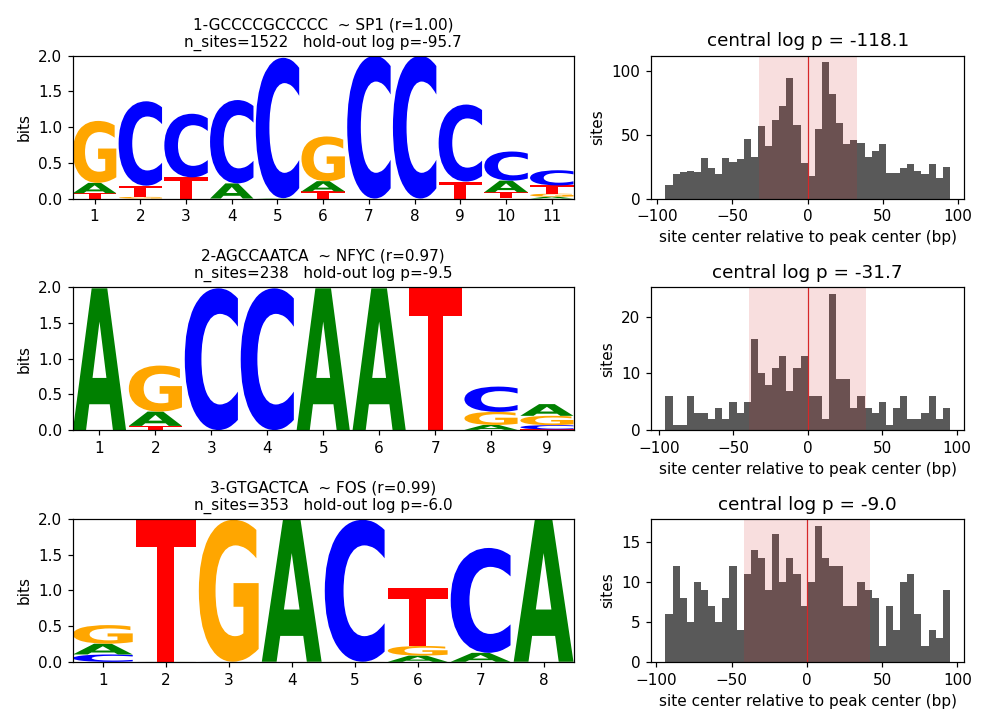
plot.report(motifs, annotation=ann) on the first 2000 SP1 ChEC-seq peaks (the
run recorded in the benchmarks), most significant first, with the HOCOMOCO
match in each title: the bound factor's GC-box is sharply central, the NF-Y
co-factor less so, AP-1 barely.
annotate ranks by the sum of per-column Pearson correlations over the
best alignment (Tomtom's Pearson metric) and reports offset and
orientation; it does not compute Tomtom's p-values. For a validation claim
run real Tomtom on the exported file (scripts/validate_streme.py shows
how).
Known motifs: scan and enrichment¶
from pystreme.meme_io import read_meme
sp1 = read_meme("tests/fixtures/MA0079.1_SP1.meme")["MA0079.1"]

hit = disc.scan(sp1.pwm)                # ScanResult: best score/position/strand per peak (both strands)
hit = disc.scan([pwm_a, pwm_b])         # batched, motif axis kept
enr = disc.enrichment(sp1.pwm)          # SEA-style: optimal threshold + Fisher p vs a matched control
enr.log_pvalue, enr.table               # (primary_above, primary_below, control_above, control_below)
one = disc.discover(widths=[8, 10])     # a single round of fit, no hold-out
Scores are log-odds in nats against the order-bg_order background;
-inf marks a sequence with no valid window (all-N).
Reproducing the benchmark¶
# needs the MEME suite (streme, tomtom) on PATH
python scripts/validate_streme.py --peaks peaks.bed --genome genome.fa \
    --n-peaks 2000 --device cuda --out validation/run
writes validation/run/summary.md with pystreme's and STREME's motifs,
Tomtom cross-matches, and both wall-clocks (run it on a GPU node; the script's docstring has the
exact invocation).